
 Locations
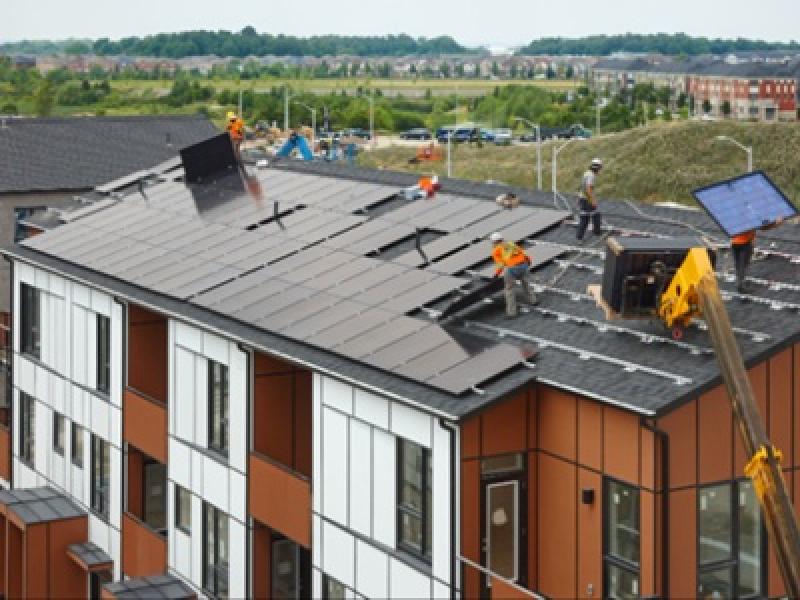




A community-scale rooftop photovoltaic system that graces the townhomes of the Daniels Corporation’s MPV2 in Brampton is a crowning feature of the low-carbon project, powering not just its heat pumps but the expected financial savings for residents.
Completed weeks ago, the 615-kilowatt solar installation is spread across 120 townhomes, capable of generating the equivalent to the annual electricity consumption of the buildings.
Clean electricity powers the energy-efficient appliances in the homes, plus the heat pumps that provide heating, cooling and hot water without need for natural gas-powered equipment.
The rooftop installation can address a problem the all-electric townhomes are expected to face, Meghan Wilson, the senior manager of sustainability at Toronto-based Daniels, said in an interview with Sustainable Biz Canada. The more a building relies on electricity, the more stress it will put on the grid.
But, “by producing on-site renewables, you’re able to soften some of those peaks and the strain on the grid, and you’re able to take advantage of 100 per cent renewable electricity,” she said.
The gains of going all-electric
A community developed and built by Daniels, MPV2 (which stands for Mount Pleasant Village) consists of two mid-rise towers and seven stacked townhome blocks. At the same time Daniels began developing MPV2 in 2021, it was finalizing its corporate sustainability strategy, coinciding with the community's design.
The solar power installation can generate enough electricity to power the annual consumption of the townhomes, overproducing during the summer and at a trickle during the winter.
As Ontario’s grid consists of mostly nuclear, hydro and natural gas sources, the rooftop solar panels can further reduce the carbon intensity of the townhomes’ electricity consumption, Wilson explained. The townhomes, which are modelled for net-zero performance, have a 74 per cent smaller carbon footprint compared to a baseline townhome community, Daniels said, primarily from eliminating operational emissions.
Additionally, the solar panels insulate residents from the fluctuating prices of natural gas and nuclear energy. “The biggest benefit is just removing a bill from your house, so you don’t have a natural gas bill at all,” Wilson said.
Residents are expected to save money through the rooftop system compared to a conventional townhome, Wilson added.
The installation went smoothly, she said, with Picton, Ont.-based Otter Energy Inc. handling the design, engineering and construction. The system is owned and operated by Toronto-based AltCrest Energy under an energy-as-a-service model which also minimizes the cost to Daniels.
Daniels did not tap into government subsidies for the solar installation, which Wilson called it a “huge win” as the developer-builder did not rely on external funding.
Sustainability enhances Daniels’ reputation
As Daniels baked sustainability into its vision for MPV2 from the beginning, it found efficiencies early in designing the community, Wilson said. Additionally, the technologies installed in the homes such as heat pumps are well-established. As a result, Daniels delivered MPV2 with little to no cost premium, she added, which trickled down to the homeowners.
While Daniels does not anticipate squeezing out financial gains by emphasizing low-carbon development for MPV2, Wilson said it equipped the company with a competitive edge in the homebuilding industry.
“If we’re able to continue to deliver a really superior product at the same or even better price point than our competitors, I think that would definitely set us apart,” she said. Daniels can meet its sustainability goals with MPV2, boosting its credibility as a homebuilder and polishing its reputation as well.
Low-carbon is ‘the future’
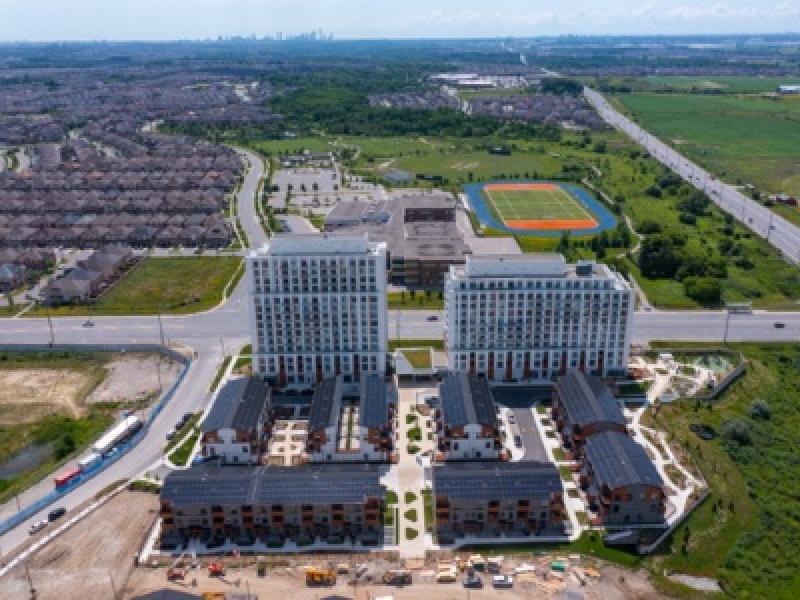
Like the townhomes, the towers of MPV2 are designed under low-carbon principles — a geoexchange system is a lead feature which uses the ground as a thermal battery for heating and cooling. Other key elements are high-performance walls and windows and energy-efficiency appliances.
Unlike the townhomes, the 314 units in the towers are not modelled for net-zero performance because of the density, Wilson said. The mid-rise condos have a 45 per cent lower carbon footprint than a typical Daniels community. Like the townhomes, most of the reduction are from tackling operational emissions, which were more than halved by comparison.
Though there are no solar panels on the towers, Daniels hopes to pilot the renewable energy equipment on the buildings in the future, Wilson said.
“Now that we cracked the nut on how these condo townhome communities can function as a single source of the solar production, I think for sure, it can be scaled.”
Other developers can learn from Daniels’ example of a low-carbon community, Wilson said. “Bringing forward these low-carbon communities, it is the future. I think the focus on decarbonization is only increasing over time.”
Daniels hopes to bring the model of a low-carbon community to its upcoming projects, such as another all-electric townhome neighbourhood being built north of MPV2.



 Industry Events
 Locations