Locations




Kathairos Solutions, a Calgary firm taking on methane emissions from oil and gas operations, has offset the equivalent of one million tonnes of carbon dioxide (CO2) since 2022, a milestone on its journey to eliminate much more.
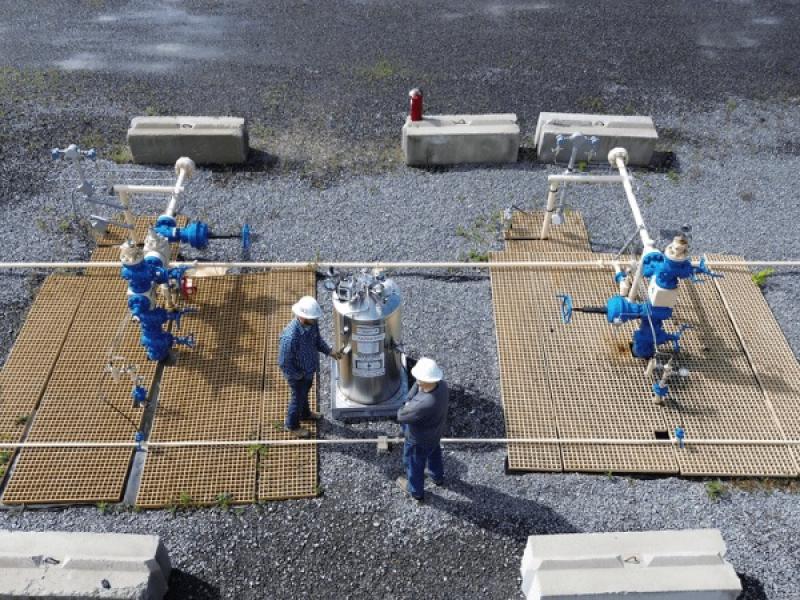
Founded in 2020 with its first commercial deployment in 2022, Kathairos substitutes the natural that powers the pneumatic equipment used in the oil and gas industry with liquid nitrogen. Rather than venting natural gas and the resulting methane, it releases nitrogen, which is not a greenhouse gas.
Methane is a potent greenhouse gas, over 80 times stronger than CO2 over a 20-year lifespan and responsible for approximately a third of the world’s warming from human activities. Intentional venting is a major source of methane emissions from Canada’s oil and gas industry, which was responsible for almost half of the nation’s methane pollution in 2023.
Technologies like Kathairos’s that limit methane could be one of the best ways to curb global warming. The company has 3,000 systems deployed in Canada and the U.S. capable of eliminating the equivalent of 1,300 tonnes of CO2 per day. In its first year of operations, it offset that much methane across the entire business in 50 sites.
“We have have very firmly established ourselves as one of the main options for addressing methane venting from pneumatics,” Jacqueline Peterson, Kathairos’s chief external affairs strategist, said in an interview with Sustainable Biz Canada. Its customers include Cenovus, ConocoPhillips, Chevon and Exxon.
Limiting gas losses, having clearer data
The smallest-scale deployment of Kathairos equipment covers one to two wells, which can offset 50 to 100 tonnes of CO2 per year, Peterson said. On the larger end, it can be 25 to 40 wells, translating to 2,000 tonnes per year.
Kathairos serves over 60 oil and gas producers in Canada and the U.S., including some of the largest in in the U.S., Peterson said, indicating its rapid pace of adoption.
In 2023, it started to launch the first of 1,000 systems in Alberta capable of eliminating the equivalent of 141,000 tonnes of CO2.
Most practically, installing Kathairos technology helps limit the loss of natural gas, which means fossil fuel producers are not losing their sellable product. But beyond economics, more companies recognize that venting methane is not a good practice, Peterson said. Customers, shareholders and investors are demanding higher environmental standards, and international markets are demanding data on methane intensity from production, she explained.
For transparency, Kathairos has developed Atlas, a digital platform that draws upon hourly data from sensors attached to liquid nitrogen tanks to calculate how much methane is being offset. On the company’s website, the amount of CO2 emissions being offset that is on display is powered by Atlas, ticking up every so often.
Companies can use Atlas to access data on their operations and identify unusual behaviour which could prompt repairs, Peterson said. The platform can also be used for greenhouse gas emissions reporting toward standards like the Oil & Gas Methane Partnership.
Uncertain regulations put Kathairos in a bind
With Canada’s methane regulations being solidified through a deal with Alberta’s government and the world taking a deeper look at reducing the greenhouse gas, it is a critical moment for Kathairos’s business.
A tightening of methane rules have been a boon for the company before. When the Canadian government issued its methane strategy in 2022 and the U.S. government announced methane regulations a year later, it blew tailwinds for Kathairos, Peterson said.
But that has changed with a new U.S. administration hostile to controlling greenhouse gas emissions and a Canadian government renegotiating methane rules with Alberta.

Under the agreement-in-principle between Ottawa and Alberta announced in March, Canada’s Enhanced Methane Regulations would be stood down in Alberta. The province would be permitted to be placed on a plan to slash methane emissions by 75 per cent against a 2014 baseline by 2035, considered equivalent to the federal regulation for a 75 per cent reduction against 2012 levels by 2030.
An analysis by the Pembina Institute found key differences between the federal and Alberta regulations, such as Alberta's having no prohibition on routine venting and flaring.
“There’s a little bit of uncertainty on both sides of the border about what the eventual requirements will be for companies to reduce their methane emissions even further,” Peterson said.
As a result, companies like Kathairos want more regulatory certainty before they set plans, which Kathairos expects by the end of the year, Peterson said.
Offsetting 10 million tonnes "entirely reachable"
While the regulatory flux has created a more challenging environment for Kathairos, Peterson said the company is still getting uptake.
It has less to do with meeting rules, she said, and more from the improvement to operational performance, having clear data, and supporting liquefied natural gas exporters who are concerned about methane intensity regulations from the European Union and East Asian countries.
Outside of Canada and the U.S., Kathairos has its eyes on the Middle East and countries like Argentina and Australia as potential markets. Its team is working on new technologies to optimize data and minimize methane emissions from sources such as oil tank venting.
Reducing the equivalent of 10 million tonnes of CO2 is “entirely reachable, especially at this pace and our anticipated growth,” Peterson said.



 Industry Events
 Locations