
 Locations



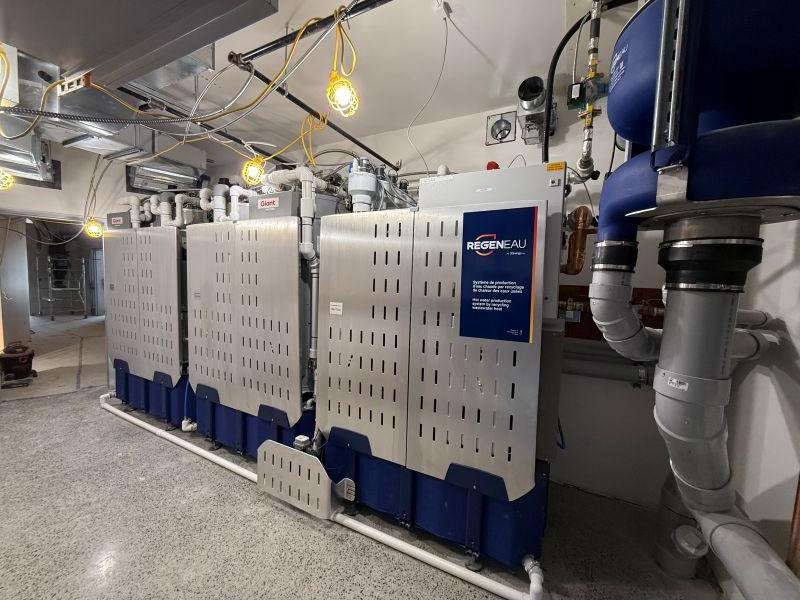
Wastewater heat is literally going down the drain in multi-unit residential buildings. Quebec City-based RegenEAU aims to capture that lost energy with technology that can reduce carbon emissions and lower heating bills.
Founded in 2018, RegenEAU has developed a system that taps into the heat from greywater (general domestic use) and blackwater (containing human wastes), and cycling it back to provide the building’s residents with hot water.
This reuses the thermal energy that would otherwise be lost in the millions of cubic metres of wastewater from sinks and taps that slithers down pipes and sewers in Canada, offsetting natural gas heaters to warm up water.
RegenEAU’s systems “heat domestic hot water in a way which cuts back on both emissions as well as the cost of heating water,” its co-founder, chief growth officer and head of strategic development Michael Pelletier told Sustainable Biz Canada in an interview.
Mike McLaine, RegenEAU’s sales and business development manager, interpreted for Pelletier in the interview.
With systems installed in Quebec and France, RegenEAU plans to expand in Canada and Europe, and service other types of buildings.
Reusing warm wastewater
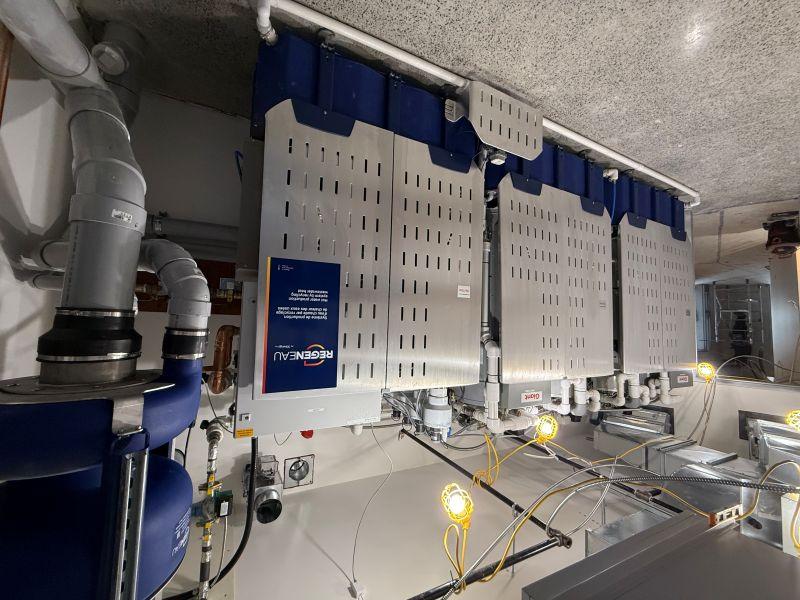
RegenEAU’s system is installed in the basement of a multi-unit building either from the get-go or as a retrofit. It gathers the wastewater and transports it toward a separator which filters the solids from the water. The water is sent to storage tanks, then moved to a heat exchanger which extracts and upgrades the thermal energy, while the solids are diverted to the sewer.
The technology can match the demand for hot water in the building, Pelletier said. If there is low demand, it can “optimize the amount of hot water being produced so that it’s available on an at-need basis through these storage tanks,” he explained.
The company’s system is unique in the wastewater heat recovery sector because of its patented separator, Pelletier said. Instead of having to “macerate solids and liquids together to try and extract the heat, we’re able to right at the source separate the solids from the liquids and then just leverage the liquids.”
This reduces costs and requires less maintenance, he said, while also eliminating the need for massive storage tanks, making it easier to install.
Energy-efficient systems save money
RegenEAU’s technology can supply up to 75 per cent of a multi-family building’s hot water needs, Pelletier said. For the 145-unit first tower of the Le Brave apartment in Quebec, RegenEAU shrank energy use by 43 per cent and cut the carbon emissions by 68 per cent compared to its baseline by reducing the need for the gas-powered water heater.
The savings extend to the pocketbook. RegenEAU’s system can halve operating costs, saving buildings with 100 to 200 units in Quebec over $10,000 per year on average, Pelletier said.
He noted that Quebec’s electricity costs are relatively affordable compared to some countries, so the savings could be amplified in certain markets. Those areas are where RegenEAU sees opportunity for expansion.
RegenEAU in 'massive commercialization'
RegenEAU has run pilot projects in Quebec and France, partnering with utilities such as Hydro-Quebec and France’s ENGIE. It has installed over 40 systems in Quebec.
After spending its first years on research and development, RegenEAU started selling its systems commercially in 2023. Today, the company is in a “massive commercialization” phase, Pelletier said.
The French market has been interested in RegenEAU’s solution because of the high energy costs it is facing, Pelletier said. That trend extends to other parts of Europe, where RegenEAU is “particularly excited.” The continent also has energy-inefficient buildings and environmental regulations pushing for more sustainability, he added.
This summer, RegenEAU’s equipment was installed in a 43-unit apartment in Paris through a partnership with Paris Habitat and ENGIE. It is expected to recover up to 60 per cent of the heat from the building’s wastewater.
Back in its home country, Ontario is a target market for RegenEAU. The company is making moves in the province such as a proof-of-concept project it hopes to close this year.
Beyond multi-unit residential buildings, RegenEAU has designs to add industrial buildings to its clientele, Pelletier said, particularly buildings that consume large volumes of hot water.
RegenEAU’s five-year growth plan is to have 100 installations of its systems per year, Pelletier said, and have manufacturing sites in Quebec and France. It is aiming to close a $10-million Series A funding round in 2027.


 Industry Events
 Locations