Locations







CURA Climate Inc. has raised US$10 million to bring mass production of low-carbon cement closer to fruition — funding aimed at moving from the pilot project stage to commercial deployment and growing its team.
The fundraise, led by Zacua Ventures, with participation from Sandpiper Ventures, Amplify Capital, and Vantage Futures, will support the construction and commissioning of CURA’s pilot facility in Taber, Alta. The project is being developed in partnership with precast concrete product maker Grand Forks Concrete.
The funds are also meant to advance engineering design for CURA’s commercial demonstration facility, also planned to be in Taber, and expand CURA’s technical and business teams.
Cement production is a large source of carbon emissions and part of a difficult-to-abate sector. CURA developed an electrochemical technology to tackle this problem, using renewable electricity to split limestone into hydrated lime, a cement ingredient.
CURA’s technology can cut carbon emissions by 85 per cent in comparison to burning limestone in kilns to produce lime, it says, and capture a concentrated stream of carbon dioxide.
“This level of financing really allows us to take it to the next phase where will be able to demonstrate in an industrial-relevant environment that the technology works,” Erin Bobicki, CEO of Calgary-based CURA, said about the funding in an interview with Sustainable Biz Canada.
From pilot to commercial-scale firm
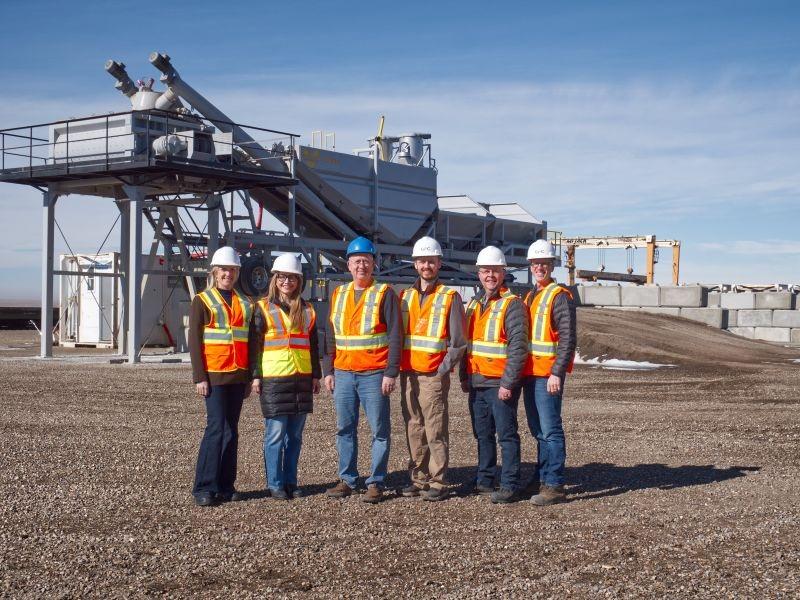
CURA took early steps this year to establish a pilot facility in Grand Forks Concrete’s precast product site in Taber that can produce 100 tonnes of hydrated lime per year. The engineering work is finished and the pilot facility is under construction, Bobicki said.
A portion of the funds will support the construction and operations of the pilot. CURA is targeting the start of operations for January 2027, running the project for one to two years.
The data from the pilot is to inform the engineering design of a 30,000-tonnes-per-year commercial demonstration facility, also to be developed alongside Grand Forks Concrete in Taber. CURA expects to have this step ready for commissioning in late 2028 to early 2029.
Hydrated lime produced from the commercial demonstration facility is to generate revenue that can “fund our further scale,” Bobicki said, with the project itself acting as a “showcase facility” for clients in the cement industry.
A portion of the cement made using CURA’s hydrated lime is expected to be used in Grand Forks Concrete’s precast products, Bobicki said, and some sold to other customers such as other precast concrete product manufacturers in the area and project developers in search of low-carbon cement.
The commercial demonstration is to provide CURA with information on its next step: a full-scale commercial facility that can output 500,000 to one million tonnes of hydrated lime.
To secure the talent to meet its ambitions, CURA plans to to expand its team using the funding. Currently at 15 full-time employees, the goal is to reach 20 CURA members by the end of the year. The company plans to bring on more engineers and chemists, along with business development experts who specialize in cement and carbon sequestration, Bobicki said.
The 'best choice' for cement decarbonization
To Bobicki, it is noteworthy that CURA raised US$10 million despite not being in the white-hot artificial intelligence and robotic sectors that are raking in the lion’s share of investment today.
Zacua, a Burlingame, Calif.-based venture fund, invests in sustainability, productivity and urbanization solutions. The fund, Bobicki said, is deeply interested in cement decarbonization, and CURA’s solution was “the kind of solution that they’ve been looking for.”
Sandpiper is a Nova Scotia-based early-stage fund specializing in supporting woman-led companies. CURA meets such criteria, being a startup with two founders out of three being women.
Toronto-based Amplify is a fund oriented around climate, health and work.
Vantage invests in aviation and transportation infrastructure. With cement used to make major airport components like runways, buildings and control towers, CURA is an appropriate match.
Bobicki envisions CURA as a global business that can decarbonize existing cement plants and make new facilities low-carbon from the start. While selling hydrated lime is to be a revenue generator for CURA, the long-term goal is to transition the company into selling its equipment and technology licenses to cement companies, Bobicki said.
“We really want to be the best choice, the best available technology for cement production and decarbonization.”



 Industry Events
 Locations