


 Locations





There’s evidence that mass timber is shifting from its demonstration phase to its delivery era, according to a leading design company behind several mass timber projects in Canada.
Updated building codes, more mass timber production capacity and client eagerness has pushed and pulled the design and construction of tall timber deeper into the mainstream, Craig Applegath, an architect and partner with design and engineering firm DIALOG, told Sustainable Biz Canada in an interview.
"We're starting to see the ramping-up of mass timber as the industry gets a real foothold," Applegath said.
According to research provided by DIALOG, 40 per cent of all mass timber buildings in Canada have been completed within the last five years, and roughly 140 mass timber buildings were either in planning or construction phases in 2024. There's likely more now, Applegath said.
"That gives you sort of a magnitude of what's going on," he said. "These are larger projects, so that's big bucks; that's a lot of capital being allocated for mass timber, and it's certainly driving... the mass timber fabricators across the country to really make sure they (can) meet that capacity."
Timber panels store carbon for decades
Concrete and steel are among the most carbon-intensive materials produced at industrial scale. Producing standard concrete generates 200 to 300 kilograms of carbon dioxide (CO2) per cubic metre, according to data shared by DIALOG. Making primary steel produces 1.8 to two tonnes of CO2 per tonne.
Wood, if used instead, displaces these materials and locks carbon away. Wood is approximately 50 per cent carbon by dry weight and absorbs carbon from the atmosphere as the tree grows. That carbon stays locked in the timber building's structure through its lifespan to the rate of about 0.9 tonnes of CO2 stored per cubic metre of mass timber.
There are three main drivers fuelling mass timber construction, Applegath said.
First, the 2020 National Building Code expanded the limit of encapsulated mass timber buildings from six to 12 floors. (Encapsulated means mass timber structures that include an additional building material layer over the timber panels, such as drywall). The code expansion gave developers, lenders and insurers the signal that mass timber, or cross-laminated timber, was ready for the mainstream and no longer experimental, he said.
British Columbia has since permitted 18-storey mass timber buildings, and Ontario has done the same.
Second, Applegath said the number of mass timber fabricators or producers has expanded around the country, providing builders the panels they need to build at scale. This increased production has also lowered lead times and costs for cross-laminated timber panels.
Third, more clients are asking for mass timber buildings, especially within municipalities and educational institutions.
Applegath added that the federal government is investing billions of dollars into defence buildings and related structures, and mass timber construction will play a role in those contracts.
The slow housing market in Canada represents one obstacle for the mass timber industry. But in the meantime, many clients are seeing mass timber as part of their strategy to decarbonize their operations. "It's a means to address some of their social requirements; their social good,” Applegath said.
Progress also boosted by seismic upgrades, supertall concept

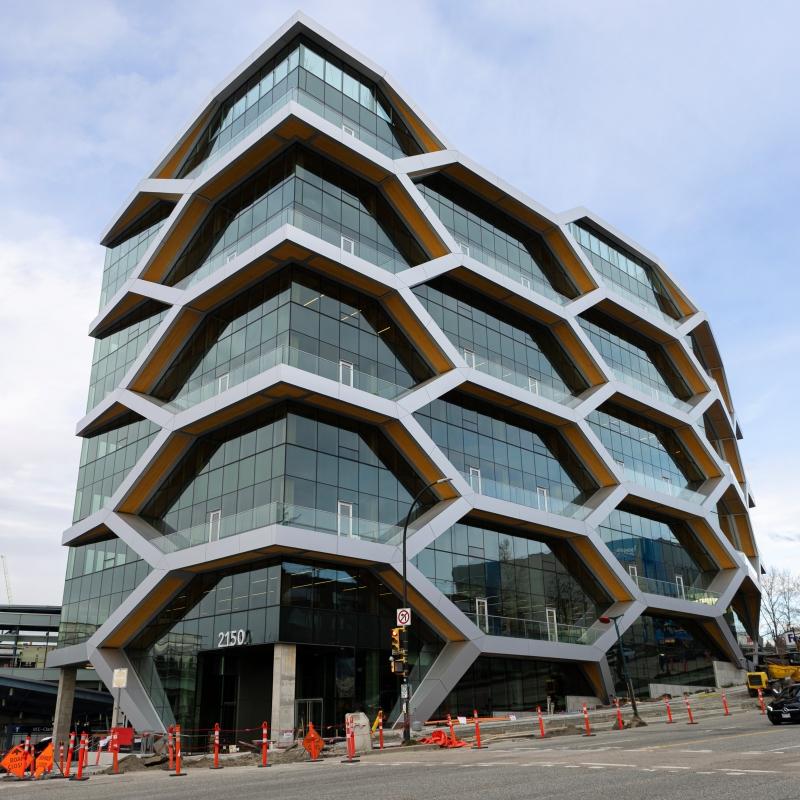
Moreover, Applegath said seismic upgrades to mass timber structures have reduced concerns over earthquakes and tall timber. For example, DIALOG and Fast+Epp developed a timber braced frame system that was used on The Hive in Vancouver.
The brace system, paired with self-centring seismic dampers called Tectonus, provides structural strength during an earthquake to protect tall timber buildings without using a conventional concrete core.
DIALOG said The Hive, a 10-storey office tower, is the tallest timber seismic-force-resisting building in North America. The Insurance Corporation of British Columbia will move its headquarters into the building.
Other breakthroughs involving DIALOG include:
- Hybrid Timber Floor System (HTFS): Conceived by DIALOG with EllisDon, the construction technology integrates timber with steel and concrete in prefabricated floors. It reduces the overall carbon footprint of construction projects and enables fast on-site assembly. Prototype testing and fire testing has demonstrated its structural integrity.
- Zero Carbon Hybrid Timber Supertall Prototype: This is a 105-storey supertall mass timber concept building made to stimulate industry conversations about the limits of tall timber designs. DIALOG partnered with EllisDon to test the construction logic behind the prototype and to provide costing analysis.
- University of Victoria Engineering Expansion Project: UVIC's Engineering Expansion is a two-building project on campus that uses a mass timber structure and low-carbon concrete to lower its overall embodied carbon emissions. Thousands of embedded sensors throughout the two buildings, now under construction, will collect real-time data on building performance, transforming the campus buildings into teaching tools around structural movement, seismic behaviour, envelope heat loss, ventilation efficiency, indoor air quality, stormwater performance and more.
Applegath said the rising interest in mass timber is obvious to him in another way.
"I used to speak once a year, and now I'm speaking four times a year about what we're doing, and it's being driven by, I think, the response by clients like universities and institutions (and) governments that have a mandate to reduce carbon," he said. "Mass timber is a hugely powerful tool to do that."



 Industry Events
 Locations
