Locations




Innovations being developed by a cohort of 17 companies supported by Vancouver-based non-profit Light House could unlock the future to a more sustainable construction industry.
Earlier in December, the organization unveiled its newest batch of British Columbia-based companies in the Circular Construction Accelerator. Light House is advising companies in the circular economy space toward scale-up and commercialization.
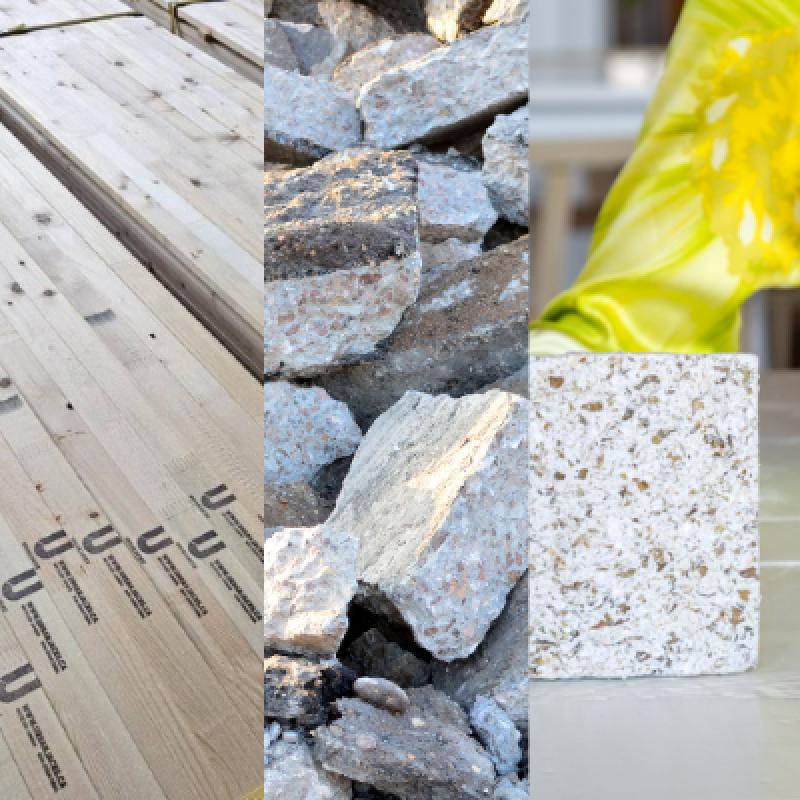
The companies are behind solutions in low-carbon building materials; modular and prefabricated building techniques; deconstruction, reuse and waste recovery; and adoption of low-carbon practices at scale. They include Rockburst Technologies, a company using carbon dioxide to break apart rocks in an energy-efficient manner, and UrbanJacks, a business reusing wood fibres to make lumber.
With Canada in need of millions more homes to improve housing affordability, there has been a high level of interest in building quickly and at scale. But Canada’s landfills are reaching capacity partly because of construction, renovation and demolition (CRD) waste, Gil Yaron, managing director of Light House, said in an interview with Sustainable Biz Canada.
Approximately four million tonnes of such discards are generated in Canada per year, the federal government says. Building operations, construction and materials also account for almost 30 per cent of Canada’s annual greenhouse gas emissions, according to the Canada Green Building Council.
But there are ways to retain the value of the CRD waste “and reintegrate (the materials) back into the economy” with circular economy practices, Yaron said, “creating entire industries that are creating jobs and supportive infrastructure.”
The Circular Construction Accelerator
Light House is an organization that advances regenerative design and circular practices in the built environment. The accelerator is a three-year program it created to fuel the growth of companies sharing Light House's vision.
The non-profit helps the companies access capital and supplies, and learn about markets, business planning and marketing. Light House also provides one-on-one expert guidance, plus access to mentors, resources and networks upon graduation from the accelerator.
Light House started with a cohort of six businesses in 2024 that have since finished the program. Those include Renewal Development, a company which relocates homes, and Infina Technologies, which developed a solution to eliminate the non-structural space inside concrete slabs.
The companies enrolled in the accelerator vary in maturity, Yaron said. Most are startups with a patented, proven technology just entering the market, while others are older firms looking to scale-up operations or introduce a new innovation, such as New West Gypsum Recycling and Lock-Block.
“These companies represent some of the most innovative work happening in the country,” Yaron said about the accelerator participants. A common theme is manufacturing innovative, sustainable products. An example is Seacork Studio, which is making acoustic panels from seaweed.

ReCap Materials, a company developing bins with material-specific dividers for constructions sites to enable easier sorting and management of waste, was noted by Yaron as a player in “reverse logistics.”
EcoWaste and NAPP Enterprises stood out to Yaron because the two companies are “multipliers” that amplify the growth of peers. For example, EcoWaste is building circular construction campuses where waste can be dropped off to be remade into new products.
“When we’re looking at trying to scale a circular economy rapidly, it’s initiatives like that (which) create a hospitable environment for these young companies to grow and flourish,” he said.
The Circular Construction Accelerator is expected to support 50 companies when finished, with the remaining 27 companies to be named next year.
Supportive policies key to circular construction sector
For Canada to shift toward low-carbon, circular construction, Yaron emphasized “good policy.” He suggests governments:
- require all public construction projects be made using a certain percentage of reclaimed materials;
- mandate demolished homes be assessed for relocation or materials reuse; and
- set requirements for construction sites to source-separate materials for capture and diversion.
Governments, developers and general contractors can add sustainable technologies into their project specifications to drive demand for circular economy services and products, Yaron said.
“We talk a lot about designing buildings in a way that will last longer and then be constructed,” he said, “but at the end of the day, it needs to go into the contracts in order to ensure that those types of practices happen.”
Light House is looking to form a business incubator for Indigenous-owned and -led companies prioritizing circularity, regenerative design and resiliency, following in the footsteps of the Circular Construction Accelerator.
The non-profit also plans to elevate awareness around sustainable modular construction in 2026, and to announce the results from its Construction Plastics Initiative in the late winter to early spring of next year.


 Industry Events
 Locations