


 Locations

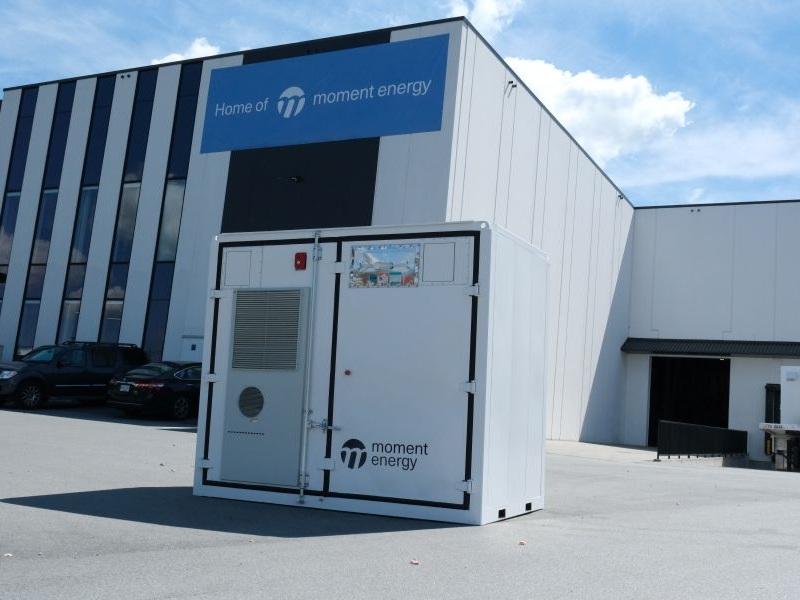


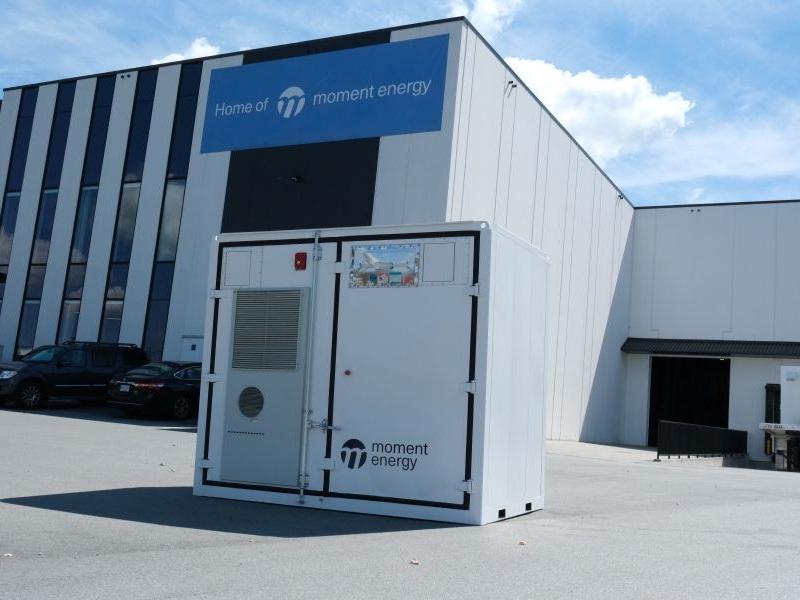
Moment Energy is betting that repurposed electric vehicle (EV) batteries can help meet growing demand for energy storage with Nova, a compact system designed to deliver reliable power to commercial and industrial customers while opening new markets for the company.
Nova is a 500-kilowatt-hour, ground-mounted, box-shaped system that weighs almost 10 tonnes. Compact enough to fit in a single parking stall, Nova can supply up to two hours of electricity for approximately 190 homes. That capacity can be extended with additional Nova units.
Vancouver-based Moment claims the product is the first of its kind to achieve the UL 1973 and UL 9540 certifications, which set safety standards for battery energy storage systems. It meets those standards with a fire prevention system and liquid cooling.
Another point of pride for Moment is Nova being the only third-party verified battery energy storage system eligible for U.S. investment tax credits in 2027 and beyond.
Moment is targeting markets in North America, Europe, Asia and Oceania, with Nova designed for applications ranging from manufacturing facilities and EV charging stations to hospitals, neighbourhoods and airports.
Moment CEO Edward Chiang described Nova as, “the continuation and acceleration to prove that repurposing of EV batteries can be commercial,” in an interview with Sustainable Biz Canada.
Safe and smart
Moment has incorporated artificial intelligence (AI) into Nova’s battery management system to extend the system’s lifespan and improve safety.
In some energy storage systems, a dead battery module demands a wholesale replacement of the device. The AI-powered management system in Nova, on the other hand, can shut down and isolate individual cells, modules and packs if they are non-functional. This allows the system to continue operating at reduced capacity while avoiding the cost of replacing the entire unit, Chiang said.
Chiang called Nova the “safest system in the entire world for repurposing of EV batteries,” including in the event of thermal runaway. The UL certifications establish Moment as the only company that can deploy refurbished EV batteries in the built environment, Chiang continued, such as the downtown areas of Vancouver and Toronto.
Moment also sees a regulatory advantage in the U.S. market. Energy storage systems made in China are banned from use in the U.S. But as a Canadian company manufacturing Nova from Vancouver, drawing from a North American supply of EV batteries rather than newly processed minerals from China, Moment’s units have been deemed compliant with the U.S. Foreign Entity of Concern rules by a third-party law firm, Chiang said.
Sourcing its batteries from used EVs is not only better for the environment, it grants Moment goodwill with the U.S. government, he continued. That may prove critical to Moment’s growth as the company establishes a beachhead in the world’s largest economy with a factory in Texas.
Bigger in Texas

Moment has laid the groundwork for a 200,000-square-foot gigafactory in Taylor, Texas, near Austin. At a proposed production capacity of two gigawatt-hours of units per year, it would have 10 times the scale of Moment’s megafactory in Vancouver which opened in June. The U.S. Department of Energy awarded the company US$20.3 million for the project in 2024.
One of Chiang’s priorities today is hiring aggressively in order to staff the Texas gigafactory with approximately 200 workers. Large-scale manufacturing is expected to commence in 2027, moved up from an earlier expectation of 2028.
Moment is pondering an expansion of its megafactory in Vancouver to keep up with demand, Chiang said, but the proposed 2026 Canadian federal budget has “made it very difficult for us to decide to expand manufacturing in Canada,” he said.
Despite the frosty trade relationship between the U.S. and Canada, the U.S. has been very hospitable to Moment, Chiang said. While the Canadian government has not forgotten Moment, providing $4.9 million via PacifiCan in 2025, the products from a company like Moment are not eligible for investment tax credits in the budget unlike the U.S., Chiang said, because Moment does not make battery cells.
Despite those challenges, Moment remains committed to Canada. Many of the company’s employees, including Chiang, are first-generation immigrants who are proud to give back to their home country, he said, even if it means not operating under the ideal business climate.
Moment continues to build momentum, attracting private investors who see it as “the fastest-growing battery company in the world right now,” Chiang said.



 Industry Events
 Locations

